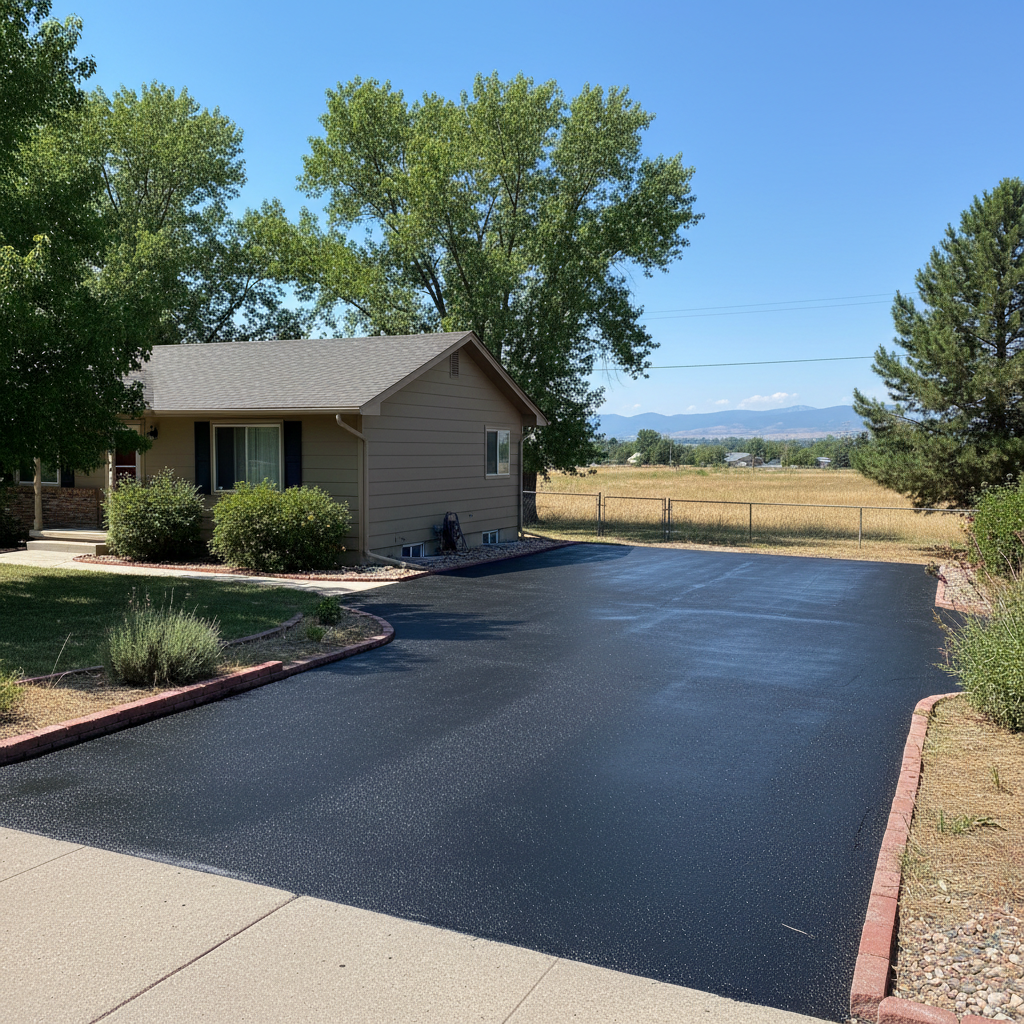
Alright, let's talk about slurry seal. You're looking at your asphalt, maybe it's starting to look a little faded, got some tiny cracks, and you're wondering if a slurry coat is the right move and, more importantly, what it's gonna set you back. As someone who's been doing this for years here in Longmont, I can tell you it's not always a straightforward answer, but I can give you some solid numbers and what to watch out for.
What Even Is Slurry Seal?
Before we dive into dollars, let's quickly clear up what we're talking about. Slurry seal isn't just a paint job. It's a mixture of asphalt emulsion, aggregates (small, fine rock), water, and some additives. We apply it in a thin, uniform layer over your existing asphalt. It's designed to protect the surface from UV rays, water penetration, and general wear and tear. It fills minor cracks and gives your pavement a fresh, uniform black look. Think of it as a protective sunscreen and a fresh coat of paint for your driveway, extending its life before you need a full repave.
What Drives the Price Tag?
A few things really push the price up or down. It's not just a flat rate per square foot because every job is different.
- Size of the Area: This is the biggest one, obviously. The more square footage, the more material and labor. But here's a trick: the larger the area, the lower the price per square foot usually gets. We can be more efficient with bigger jobs.
- Condition of Your Pavement: If your asphalt is riddled with potholes, deep cracks, or has major drainage issues, we'll need to do some repair work first. Slurry seal is a preventative and restorative measure for *minor* issues, not a miracle cure for a failing driveway. Patching, crack filling, or even some base work will add to the cost.
- Number of Coats: Most residential driveways in Longmont will get a single coat, sometimes two for extra durability or if the existing surface is particularly rough. Commercial lots often get two coats to handle heavier traffic.
- Accessibility: Is it easy to get our equipment in and out? Is there a lot of intricate cutting around landscaping, or is it a wide-open space? Tight spaces or areas requiring a lot of handwork will take more time and effort.
- Prep Work Required: Every job needs cleaning – sweeping, blowing off debris, maybe some power washing. But if there's a lot of oil stains, weeds growing through cracks, or significant loose aggregate, that's extra prep time.
Typical Cost Ranges in Longmont
Alright, let's get to the numbers. Remember, these are general ranges for 2024, and your specific quote will depend on the factors above. I'm talking about a professional job, done right, with good materials, not some fly-by-night outfit.
- Residential Driveways (1,000 - 2,000 sq ft): For a single coat, you're generally looking at anywhere from $0.50 to $0.80 per square foot. So, a 1,500 sq ft driveway might run you $750 to $1,200. If it needs significant crack filling or two coats, that could push it up to $0.90 - $1.20 per square foot, or $1,350 to $1,800 for that same 1,500 sq ft.
- Larger Residential or Small Commercial (2,000 - 5,000 sq ft): The price per square foot usually drops a bit here due to efficiency. Expect $0.40 to $0.70 per square foot for a single coat. A 3,000 sq ft area could be $1,200 to $2,100.
- Commercial Parking Lots (5,000+ sq ft): These jobs are often priced more competitively per square foot. For a single coat, you might see $0.35 to $0.60 per square foot. For a 10,000 sq ft lot, that's $3,500 to $6,000. Many commercial jobs opt for two coats, which would naturally increase the total.
Keep in mind, these are for slurry seal specifically, not just a cheap sealcoat. Slurry seal uses a much thicker, more durable aggregate mix.
What Should Be in Your Quote?
When you get a quote from Integrity Paving or any reputable company, it should be clear about a few things:
- Square Footage: The exact area being treated.
- Number of Coats: One or two.
- Prep Work: What's included? Sweeping, blowing, minor crack filling (usually up to a certain width). If there's extensive crack filling or patching, it should be itemized separately.
- Materials Used: While you don't need the chemical breakdown, it's good to know they're using quality asphalt emulsion and aggregates.
- Timeline: When they plan to start and finish, and how long you'll need to stay off the pavement.
- Warranty: What kind of guarantee do they offer on their work?
A good quote won't just be a single number. It'll break things down so you understand what you're paying for.
How to Avoid Overpaying
You don't want to get fleeced, and you shouldn't. Here's my advice:
- Get Multiple Bids: Three quotes is a good number. Don't just go with the cheapest; compare what's included.
- Ask for References: A good contractor will happily provide them. Check out their past work if you can.
- Verify Insurance: Make sure they're insured. If something goes wrong on your property, you don't want to be liable.
- Don't Rush: Be wary of anyone pushing you for an immediate decision or offering a 'today only' discount. Quality work takes planning.
- Understand the Scope: Make sure you and the contractor are on the same page about what's being done. Are they just sealing, or are they doing repairs too?
- Local Knowledge: This is a big one. Longmont's weather, with its freeze-thaw cycles and sometimes brutal sun, means you need materials and application techniques that hold up. Someone who knows the local conditions, like the expansive clay soils we sometimes deal with in areas like Prospect, understands how that affects asphalt and what kind of prep is needed.
Slurry sealing is a smart investment to protect your asphalt. Just do your homework, ask the right questions, and make sure you're working with someone who knows their stuff. You'll save money in the long run by extending the life of your pavement, and you'll get a great-looking surface to boot.